

We are saying goodbye to the Soviet era. Which is to say: to our own lives
—Svetlana Aleksievich
Photography: Paolo Rapalino
The journalist from Novaya Gazeta is a lanky young woman with a wide smile and oversized glasses. In the foyer of the Volgograd Youth Theater, she suddenly lifts a tiny microspore connected to a cassette recorder, holding it just inches from my face. Our eyes meet, and for a moment, neither of us knows what to say. What can you say in a moment when everything around you feels utterly historic?
A few months earlier, the government of the city of Volgograd had invited us to present our production at the city’s Youth Theatre. Roberta the actress, Paolo the photographer, and I, the director, don’t let the opportunity slip away.
Roberta and I had worked on a production of Happy Days by Samuel Beckett, in which she was, in our version, the sole performer. In our version, Winnie—the main character—was half-buried in a six-meter-wide wedding skirt, on which the audience was invited to sit. For fifty minutes, Roberta’s extraordinary performance brought Beckett’s strange, tenacious creature to life.
The play’s haunting image of Winnie, buried up to her waist in a barren, lunar landscape, somehow mirrored the disorientation and strange suspension we would experience during our journey through Russia.
Here they are, the Russians.
They are sitting neatly on folding chairs arranged in rows, and even timidly on the large skirt of white organza, as wide as the entire stage. In a few moments, they will watch a performance they won’t understand at all, spoken in a language of which they know only a few words, like allegro, pianissimo, pizza, and maybe a snippet or two from a pop song. In silence, they wait.
I look at them the way one observes kangaroos, orangutans, lemurs: they’re similar, yet irredeemably different from us. And I’m sure they’re looking at us with the same anthropological curiosity.
These Russians are here for the same reason that we traveled four thousand kilometers by train, plane, riverboat, subway, bus, and reckless taxi: the desire to see creatures from another planet.
In August 1992, Yugoslavia was slipping into civil war. In Italy, politics is shaken by the biggest corruption scandal in its history, while the fight against the mafia continues to claim numerous—and high-profile—victims. In Los Angeles, the beating of Rodney King sparks a bloody riot. Running the world: George H. W. Bush, John Major, Yitzhak Rabin, Boris Yeltsin, and Pope John Paul II.
The World Wide Web was born just one year earlier.
For just over six months now, the Soviet Union—the largest country on Earth—no longer exists.
Our first encounter with the fallen giant comes in the form of a young policeman’s face. He wears a cap adorned with the emblem of the hammer and sickle set against a ruby-red background. From inside the glass passport booth, he looks at us and smiles.
It’s hard to explain now what it meant to cross that border. For decades, a literal iron curtain had concealed the socialist paradise—or the communist hell—depending on which side of the divide you stood. Those few who had visited the USSR came back with wildly conflicting stories. To us, Soviet Russia was an imagined land—judged from afar, approached with caution. A monolith barely chipped away by glasnost, Gorbachev’s short-lived policy of transparency and openness that had begun to loosen state censorship.
Since December 1991, the Soviet Union had ceased to exist. What lay before us was a new country: open, capitalist, part of the so-called free world. But in its bloodstream, its habits, its way of looking at life, this vast nation was still deeply Soviet.
Our idea of the Russians was vague, but always looming: Stalin and Tolstoy, Nureyev’s elegance, Brezhnev’s stone gaze, the movies of Andrey Tarkovsky, the elegance of Olga Korbut and Anna Akhmatova. And in the background, Sting’s refrain: I hope the Russians love their children too.
At the Moscow airport, we meet our guide, Andrey, a blond, chain-smoking Volgograd Cossack with a laid-back charm and a knack for improvising.
We squeeze onto a packed public bus, steering clear of the swarm of taxi drivers buzzing around the tourists at the curb. That’s when we hear it for the first time—the phrase that will echo throughout our trip: “Italians? Ah, Italians…”
Always the same tone: a blend of surprise, curiosity, and a hint of tenderness.
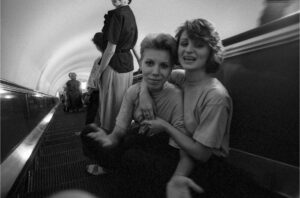
In the city, the steep escalators take us into Belorusskaya station, the first solemn nave of Stalin’s underground cathedral. Originally planned as a network of 13 stations, the Moscow metro now has 263 stops, stretching over 500 kilometers and serving around eight million passengers every day. It’s as if the entire population of New York City disappeared underground each day.
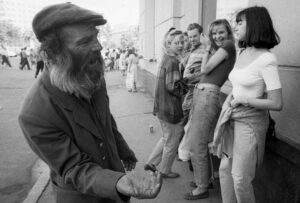
The Arbat, Moscow’s old merchant street, is swarming with makeshift vendors. On camping tables, baby strollers, kitchen chairs, cardboard boxes, or just plain bed sheets laid out on the sidewalk, you can find just about anything—mostly Soviet relics, archeological souvenirs for the few tourists wandering the scene.
We exchange a hundred-dollar bill with a street currency dealer who offers twelve times the official rate. In return, he hands us five or six thick wads of rubles—bundles the size of toilet paper rolls. We’ll carry them for the rest of the trip, unable to spend them fast enough.
“What do you want to see now?” Andrey asks.
I give him an ambitious list: the Stanislavski Moscow Art Theatre, Alexander Tatarsky’s animation studio, the Tretyakov Gallery, Mosfilm studios, Lomonosov State University, Lenin’s Mausoleum, and the Patriarch’s Ponds—where The Master and Margarita, Mikhail Bulgakov’s surreal novel, begins.
Andrey grabs the phone and begins making calls—climbing the hierarchy behind each of these institutions. On each call, he delivers the same line: An Italian visitor—a great director, a famous illustrator or artist—wants to visit you.
And just like that, we’re welcomed everywhere with open arms.
From the river station on the Moskva River, we board the motor ship Nikolai Karamzin. It can hold up to 260 passengers, but we are no more than forty on board. Of those, the three of us are the only foreigners.
Out on the wide plaza of the river terminal, a red Lincoln Continental convertible pulls up. While the driver unloads a suitcase, the passenger walks toward us. He’s a friend of our hosts, also named Andrey—soon nicknamed Andrey the Second. He introduces himself as a businessman.
Many of the people we meet introduce themselves as biznesman, flashing bilingual business cards with Cyrillic and Latin scripts side by side. Most are middlemen of some kind, dealing in anything that might tempt Western buyers: timber, amber, metals, handcrafted goods, silverware—and, though it’s better left unspoken, weapons. In this case, the real businessman is the brother of Andrey the Second, who sends a trainload of timber to Germany each week, raking in a small fortune. Andrey the Second just enjoys the perks. The Lincoln glides away. We’ll see it again at the port of our destination, a thousand kilometers to the south, waiting for its owner.
We set sail at sunset, heading into the Moscow Canal—a waterway that links the Moskva River to the mighty Volga. From there, our journey winds south, with stops in Uglich, Kostroma, Nizhny Novgorod, Kazan, Samara, and Saratov, before reaching the Caspian Sea at Astrakhan.
Our destination lies just before the end of the route: in about ten days, we’ll disembark in Volgograd—the city known from 1925 to 1961 as Stalingrad.
The crew of the Karamzin is split between the sailors, all in uniform, and the service staff, mostly young women. The girl who waits on our table wears a cascade of black curls and a thin gold necklace with a Star of David pendant. Just months earlier, such a display of religious identity wouldn’t have been welcome.
Early in the morning, someone pounds on our cabin door like it’s a police raid. We’re too slow to respond, and a maid bursts in shouting, “Uborka! Uborka!” For a second, I have the absurd urge to stand up and put my hands against the wall—just like we used to do at high school parties when the cops showed up. But all she means is: “Cleaning.”
During the day, we explore the towns and cities along the river. At each stop, we pick up beer, half-liter vodka bottles, and taranka—dried fish eaten like snacks. Evenings stretch late into the night with long conversations, drinks, and whatever snacks we’ve gathered. We speak in Russian, English, and the occasional word of French, mixed with gestures and expressions. By the final night, I can even tell old jokes in Russian—and get real laughs.
Andrey talks about his military service in Chechnya—a region that, in two years’ time, will be at war with Russia. He says the Red Army was held together by layers of paint. Since there were no funds for repairs or replacements, everything was repainted—tanks, trucks, barracks. Layer after layer, until the paint jammed the hatches, locked the gun turrets, froze the tracks.
The maids, sailors, and engine room workers in blue overalls gradually join our group. They accept a drink and bring us leftover desserts from dinner. They’re all young. They’ve all read the great Russian classics, along with the French, Dickens, and Jonathan Swift. But when it comes to the rest of the world, their knowledge is vague at best.
The curly-haired waitress tells us she’s waiting for permission to emigrate to Israel. She wants to see the world. Uborka, the cleaning girl, drinks quietly, eyes cast down. She’s barely sixteen, and she listens to everything we say. A young man from the engine room wants to know how it’s possible that Italians invented both opera and fascism. I don’t know what to tell him. They’re bewildered to hear how creatively Italians have learned to blaspheme—finding ever-new ways to curse God. They ask us to sing, and are surprised we don’t know any Italian songs. When a sailor belts out Lasciatemi cantare—a popular Italian tune—as if it were a grand opera aria, the whole deck bursts into applause.
They all seem suspended in limbo—caught between the rubble of a useless past and a future they can’t quite grasp. Caught between fierce anger, a vague sense of defeat and abandonment, and an immense curiosity for the new world.
In the towns where we dock, so much of Russia’s history was made. But now they are mostly deserted. The tourists—almost all from the newly minted Russian Federation—immediately recognize us as foreigners.
The riverbank at Uglich is crowded with sacred buildings bearing evocative names: the Resurrection Monastery, the Church of St. Dmitry on the Blood, and the Wondrous Church of the Alexeevsky Monastery. We attend a religious service where priests and nuns outnumber the congregation. Among the few in attendance, there are many young women. It’s tempting to see a religious revival among the younger generations, especially the women. But visiting a handful of reopened churches doesn’t make for solid statistics. Maybe those girls were there simply out of curiosity, just like us.
In Kostroma, an old military van picks us up from the port and takes us to the outskirts of town, to a post office with telephone booths.
I fill out a form with the recipient’s details. On the line, I hear my mother’s voice. The operator asks her in Russian if she accepts the charges. ‘Just say “Da”!’ I urge. I have to repeat it several times until my father—who had been deported during World War II and knows a bit of Russian—finally says the word “yes” in Russian, loud and clear.
My mother asks, “How’s it going?” I try to summarize the thousands of impressions, glances, and encounters that have overwhelmed us in these few intense days. I think about how to explain that we’re on a distant, different planet that is, in the essentials, so much like home: the chit-chat, the curiosity, the desire to share. I want to tell her that the Russians do love their children, too. But the operator’s stern gaze makes me anxious, and I lose my train of thought. “Fine,” is all I manage to say.
In the riverside park at Nizhny Novgorod, newlyweds ask us to join their wedding photos. We’re surrounded by boys and girls eager to practice the English they learned in school. They speak in textbook-perfect sentences, overly precise. It’s a strange conversation, hollowed out of meaning—like something straight out of a language manual.
Until the year before, the city was called Gorky and was a closed city—one of the USSR’s main tank production centers. Closed cities were considered “sensitive zones” due to the presence of military or nuclear facilities. Citizens couldn’t freely enter or leave; some didn’t appear on maps, and others had no official name. In exchange, residents enjoyed better living conditions, superior healthcare, and higher salaries. Even today, Russia still has around 38 closed cities.
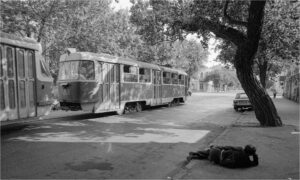
After ten days of sailing, chatting, joking, and visiting churches, our ship docks beneath the giant flying-saucer-shaped river station in Volgograd. The convertible Lincoln is waiting for Andrey the Second on the port dock.
When it was still called Stalingrad, Hitler targeted the city not just for its military factories, but for the name it carried: that of Iosif Vissarionovich Dzhugashvili—better known as Stalin, the Man of Steel. Capturing Stalingrad would have meant a symbolic blow, a humiliation of his greatest enemy. Between July 1942 and February 1943, nearly two and a half million soldiers tore each other apart in what became a legendary battle. Like the sieges of Troy, Constantinople, or Vienna, Stalingrad gave rise to an epic that signaled the start of a new era.
We’re given a fairly spacious apartment on Ulitsa Lenina—still called Lenin Street. We shop at an open-air market where the meat counters are full, but the refrigeration is turned off, honey is sold in three-kilo jars, and plastic bags are a rare luxury. Homemade—and illegal—caviar is easy to find. The best sellers, we’re told, are Chechens, Georgians, and Azerbaijanis who arrive by train or car with their goods.
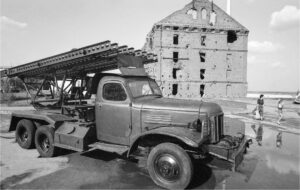
An Ossetian cab driver offers us a full tour of the city for just ten U.S. dollars. We begin at Gerhardt’s Mill—an old brick building left in ruins after the Battle of Stalingrad, its bullet-ridden walls preserved as a memorial. Nearby stands the monument to the Pavlov House, the site of a legendary siege. The car, a rickety Soviet model from the 1960s, barrels through the streets at an alarming speed while the driver—who introduces himself as Giorgio—narrates energetically, using sweeping gestures. Fortunately, the avenues are wide and almost completely deserted.
We pass the Tractor Factory, the Red October Factory, and Mamaev Kurgan—names that still echo with the memory of the Battle of Stalingrad. The hill, Mamaev Kurgan, has been transformed into a vast memorial. A concrete path winds upward to a solemn rotunda that guards an eternal flame, held aloft by a massive hand that seems to rise from the ground itself. Surrounding the flame are stone walls inscribed with the names of the fallen. When we visit, the site is deserted, but the changing of the guard takes place with undiminished solemnity.
Above us towers The Motherland Calls!, an 85-meter statue of a young woman—an allegory of Mother Russia—brandishing a sword. It’s all solemn and melancholic, heroic yet as distant as Stonehenge, lonely and gray like a forgotten monument in a city suburb.
The premiere of our production has just ended. At the Volgograd Youth Theater, we’re surrounded by a curious, eager crowd—mostly young people—lining up to offer us baskets of fresh fruit. Many of them will return night after night. I feel like an exotic creature, a kind of Gulliver encircled by amazed and inquisitive hosts. And I have to admit: for all our years of interest in the Soviet Union, nothing prepared us for what we found.
What surprised us most was the attention the play received. Roberta performed in Italian, using a challenging text rich in nuance and complexity. And yet, the audience keeps coming back. Some have even found the script and read it. They want to understand, to dig deeper, to connect with this foreign world that’s entered theirs—and unsettled it.
They smile, they are kind, but they know they’re a lost generation. A generation in-between, one that graduated with at least one course in Leninist culture. Raised in an enclosed but supportive world, they’ve seen their sense of power and collective identity crumble between their fingers. Now flung into another planet with different rules, they’ll need to adapt—fast. It’s a law of nature: only those who adapt quickly will survive. Even then, it’s already clear who will make it: the new breed of aggressive, often ruthless businessmen who will lay the groundwork for the oligarch-driven society that will soon dominate Russia. The others—those left behind—will be cast aside as nostalgics, sovoks, irrational idealists who’ve forgotten the horrors of Stalinism, of totalitarian rule, of endless bread lines.
When history leaps forward, there’s no room for nuance.
But I can’t seem to form a clear picture of where this vast country is headed. I can’t take a bird’s-eye view—because I’ve been down among the people, immersed in their daily thoughts, which, in the end, aren’t so different from my own. Except for one thing: their past has bled dry and turned to stone. In that state, it can no longer provide a solid foundation to build upon. They are weightless orphans.
In Novaya Gazeta, the article recounting our visit ends like this:
They came to Russia for the first time, hoping to find friends and like-minded people. And perhaps, in hindsight—amid their surprise and yearning to understand—they actually did.